
ENVIRONMENTAL IMPACT STUDY

By: Ameyalli Guzmán Silva


Environmental impact assessment is an environmental policy instrument whose main objective is to prevent, mitigate and restore damage to the environment. Furthermore, it regulates works or activities to avoid or reduce their negative effects on the environment. This procedure has a preventive character and must be carried out before the development of the regulated works and/or activities, in accordance with the federal and local legislation of each entity. This is done by submitting the Environmental Impact Statement or the Preventive Report.

At the federal level, the General Law of Ecological Balance and Environmental Protection (LGEEPA), in its Chapter IV, Section V, defines the Environmental Impact Assessment. In particular, article 28 establishes the works and activities that require, in a mandatory manner, the environmental impact authorization by SEMARNAT. Likewise, the LGEEPA Regulation on environmental impact, in its article 5, details the works or activities subject to authorization, as well as the applicable exceptions.

CEMGI has a specialized interdisciplinary team to help define the type of study and the appropriate expertise for the project or activity you intend to develop. Our team conducts both fieldwork and office work for each phase of the study, in addition to managing the permitting process and following up until a final decision is reached. We offer services throughout Mexico.

We have participated in environmental impact assessments at the federal level for the mining, water, industrial, general communication routes and hazardous waste treatment sectors. At the state level, our experience includes projects such as storage and distribution warehouses, self-service stores, department stores, bottling plants, special handling waste treatment, chemical industry, among others.


ENVIRONMENTAL AUDIT

By: Luis Guzmán Ramírez


Environmental audits are fundamental tools in the environmental management of organizations, as they provide information on the degree of regulatory compliance and the efficiency of natural resource use. In Mexico, these audits have gained relevance within the context of current environmental legislation and international commitments to sustainable development.

Environmental auditing in Mexico is regulated by the General Law of Ecological Balance and Environmental Protection (LGEEPA), which establishes the framework for pollution prevention and control. The Federal Attorney’s Office for Environmental Protection (PROFEPA) administers the National Environmental Audit Program (PNAA), which aims to improve the environmental performance of participating companies through specialized audits.

For their part, the states of the Mexican Republic have the authority to create and implement Environmental Audit Programs through their Ministries of the Environment or Environmental Protection Agencies. In creating these programs, these entities consider the specific conditions of their territory, as well as existing environmental audit programs and the National Environmental Audit Program (PNAA). Thus, they can mandate audits for certain industrial sectors or activities that generate significant environmental impacts and encourage voluntary audits by providing regulatory or tax incentives.

If your company seeks to improve its environmental compliance and optimize its operational performance, CEMGI offers specialized environmental audit services within the National Environmental Audit Program (PNAA), as well as in the state environmental audit programs of Mexico City, the State of Mexico and Tlaxcala.

Our experts conduct comprehensive audits, ensuring the identification of environmental risks, compliance with legislation, and the implementation of best sustainability practices within your organization. With our assistance, you can obtain environmental certifications that enhance your reputation and competitiveness in the market.

POST-CONSUMER PRODUCT WASTE MANAGEMENT PLAN

By: Ilse Reséndiz Santiago

_

A Management Plan is an instrument designed to minimize the generation and maximize the valorization of waste. This instrument is governed by the principle of shared responsibility, which implies the participation of manufacturers, importers, distributors, marketers and end consumers. That is, it involves all the people and entities that intervene from the moment a product is considered until the end of its useful life, when it becomes waste. Likewise, the plan describes the comprehensive management that will be given to the waste or waste, covering everything from collection, transportation to final use.

In Mexico City, it is mandatory to generate a Post-Consumer Product Waste Management Plan for reusable plastics, compostable plastics, and electrical and electronic equipment. These plans must be developed by the producers, marketers, and distributors of these products. The obligation to submit these plans is established in article 28 of the Regulations of the Law on Solid Waste of the Federal District. Furthermore, they are specifically regulated by:

Environmental Standard NADF-019-AMBT-2019 – Electrical and Electronic Waste – Requirements and specifications for its management, published on October 19, 2020 and in force since December 18, 2020, which establishes the requirements for the management of electrical and electronic waste.

Environmental Standard NACDMX-010-AMBT-2019 – Technical specifications that single-use plastic bags and products must meet, published on February 25, 2022 and in force since August 24, 2022, which establishes the criteria for the management of waste generated by reusable and compostable plastic products.

Since its founding 16 years ago, CEMGI has worked on the development of Management Plans, positioning itself as a pioneer in the development of Management Plans for Post-Consumer Product Waste. He has collaborated with various companies that market electrical and electronic devices, as well as with producers of compostable plastics, including latex balloons.

CEMGI is distinguished by its highly trained team, which develops plans in strict compliance with the criteria established by the Ministry of the Environment of Mexico City. In addition, the company stays constantly updated on regulations and best practices in waste management. With a solid track record and a focus on sustainability, CEMGI is the ideal partner to ensure regulatory compliance and efficient waste management for your company.

SUMMARY

A Management Plan is an instrument that seeks to reduce waste generation and maximize its valorization, promoting shared responsibility among manufacturers, importers, distributors, marketers and consumers.

This plan covers the comprehensive management of waste, from its collection to its final use.

In Mexico City, it is mandatory to develop a Management Plan for reusable, compostable plastics and electrical and electronic equipment, according to article 28 of the Regulations of the Solid Waste Law. The environmental standards NADF-019-AMBT-2019 and NACDMX-010-AMBT-2019 specifically regulate the handling of these wastes.

CEMGI, with 16 years of experience, has excelled in the development of these plans, collaborating with companies in the sector and ensuring compliance with current regulations, thanks to its trained team and its focus on sustainability.

Environmental taxes in Mexico

By: Patricia Cabrera Quiroz


Environmental taxes, also known as green taxes, are economic instruments that incorporate the negative environmental costs associated with the production or use of goods. These taxes have two main objectives: first, to influence the behavior of consumers and producers by discouraging the consumption of products or activities that harm the environment; and second, to increase government revenue by allocating the funds obtained to the environmental sector.

These taxes are applicable to individuals and legal entities considered as fixed sources within the territory of the federal entities, which levy a tax for the emission of greenhouse gases into the atmosphere.

The creation of state-level environmental taxes in Mexico was upheld by the Supreme Court of Justice of the Nation in 2019. As a result, in 2023, thirteen states implemented these taxes, with Zacatecas being the first. Other states that have already enacted these taxes include Mexico City, the State of Mexico, Guanajuato, Nuevo León, Querétaro, San Luis Potosí, and Yucatán.

State green taxes can be classified, primarily, into:

  • Tax on the Extraction of Materials from the Soil, Subsoil, Stone and Minerals.
  • Tax on Emissions of Gases into the Atmosphere.
  • Tax on the Emission of Pollutants into Soil, Subsoil and Water.
  • Tax on the Deposit or Storage of Waste.

CEMGI has a highly specialized interdisciplinary team for determining green taxes at the state level, ensuring strict compliance with the specific guidelines of each state and their respective regulatory updates. These guidelines cover, among other aspects, the identification of obligated entities, the emissions generation period, the type of discharges and greenhouse gases considered, the tax base, the applicable rates according to the type of base, the established deadlines for filing monthly and annual returns, as well as the existence of subsidies and compensation mechanisms derived from the implementation of pollution reduction strategies.


SUMMARY
Environmental taxes, or green taxes, are economic tools that reflect the negative environmental costs of producing and using goods. Their objective is to influence the behavior of consumers and producers, discouraging activities harmful to the environment, and increasing government revenue to finance the environmental sector. These taxes are applied to individuals and corporations that emit greenhouse gases within the federal entities.

The creation of these taxes was approved by the Supreme Court of Justice of the Nation in 2019, and in 2023, thirteen states, including Zacatecas, Mexico City, and the State of Mexico, implemented them. Green taxes are classified into four categories: extraction of materials, gas emissions, pollutant emissions, and waste storage.

CEMGI has a specialized team that ensures compliance with the regulatory guidelines of each entity, covering aspects such as the identification of obligated parties, issuance periods, and applicable fees. They have also collaborated in determining environmental taxes in the State of Mexico and in assessments of their applicability in other states of the country.

OPERATING LICENSE (TEPOTZOTLÁN, STATE OF MEXICO)

By: Alejandro Beas Figueroa


The Business License is the document that authorizes the operation of a business at a specific establishment. It is issued by the Directorate of Economic Development and Promotion of the Tepotzotlán City Council and can be requested by both individuals and legal entities. This license must be obtained before operations begin and is valid for one fiscal year, being renewed within the first quarter of each year.

To obtain it, it is necessary to have the authorizations of Civil Protection and Environment, as well as verify that the property is suitable for the activity, through the Land Use License.

Article 76 of the Tepotzotlán Municipal Code establishes the requirement for this license for commercial, industrial, and service activities, among others, and indicates both its validity period and renewal period. Furthermore, the Tepotzotlán Municipal Regulations for Commerce, Industry, Services, Entertainment, Advertising, and Public Thoroughfares specify the requirements to be met according to the type of activity to be carried out.

The lack of an Operating License or failure to renew it on time may result in penalties such as temporary or permanent closures, fines or cancellation of the license, in accordance with the provisions of article 96 of the Municipal Code.

At CEMGI, we have a multidisciplinary team specializing in helping companies not only obtain their Operating License, but also comply with the required prior authorizations. We are registered with the General Coordination of Civil Protection and Comprehensive Risk Management of Estado de Mexico to develop Specific Civil Protection Programs and have extensive experience in managing environmental and urban development permits.

With over 9 years of experience working with various companies and industrial parks in Tepotzotlán, we have acquired a deep understanding of the processes with the involved departments, which allows us to offer comprehensive solutions that guarantee regulatory compliance for our clients’ operations.

OPERATING LICENSE (TULTITLÁN, STATE OF MEXICO)

By: Alejandro Beas Figueroa


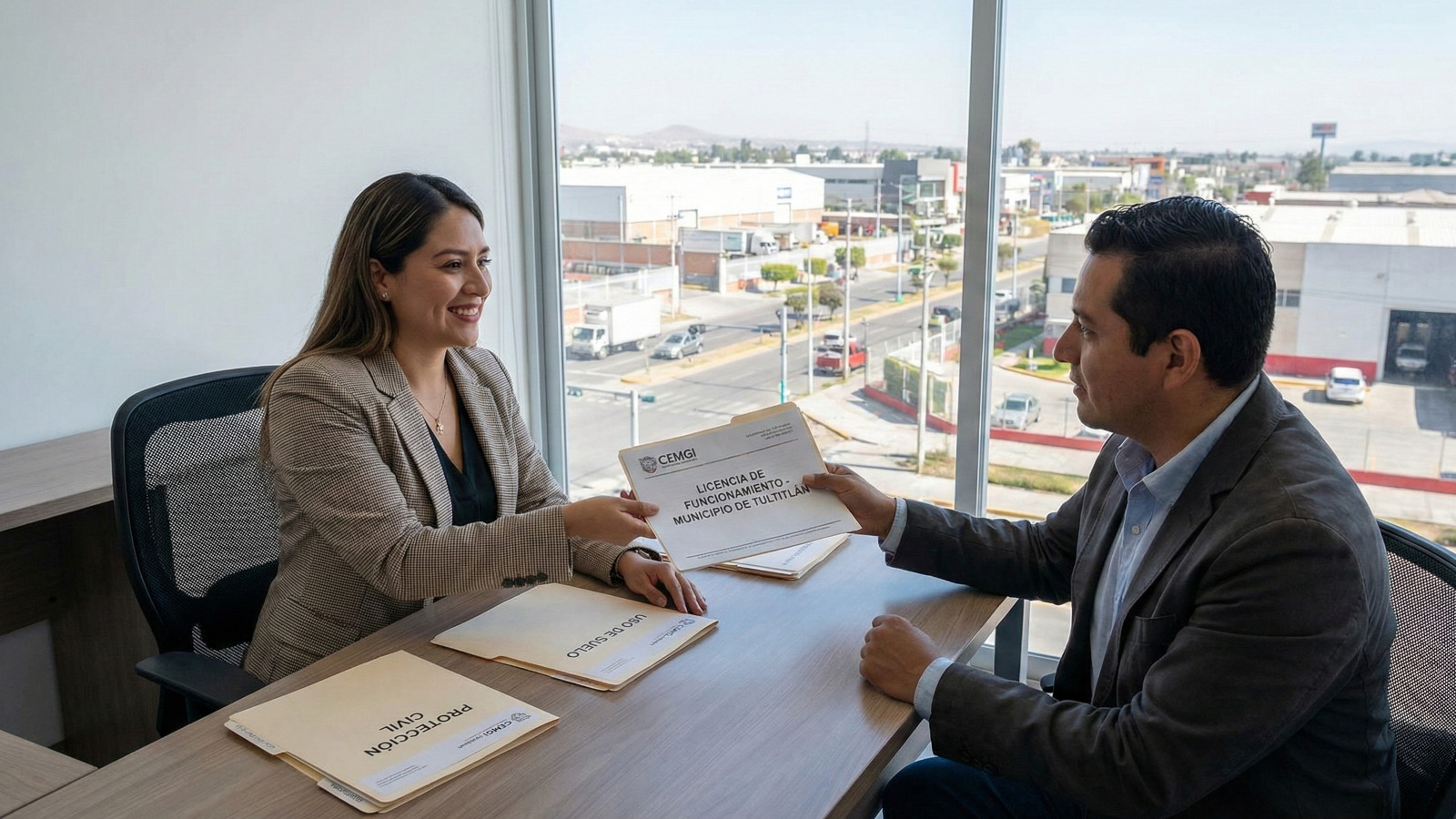
A Business License is the document that authorizes the development of economic activities in a specific sector. This permit is issued by the Economic Development Department of the Tultitlán City Council. It is mandatory for all establishments that generate economic activity, whether owned by individuals or corporations.

This procedure must be completed before the establishment begins operations. In the case of a renewal, it must be processed within the first three months of the year. The document is valid for one fiscal year.

To obtain the Operating License, it is necessary to have prior authorization from Civil Protection and verify that the property where the activity will be carried out has the corresponding Land Use License.

If the establishment does not have a valid Operating License, it could face sanctions or suspension of activities, in accordance with the provisions of articles 72 and 73 of the Regulations for Economic Activities of the Municipality of Tultitlán, State of Mexico.

At CEMGI, we have a multidisciplinary team specializing in helping companies not only obtain their Operating License, but also comply with all required prior authorizations. We are registered with the General Coordination of Civil Protection and Comprehensive Risk Management of the State of Mexico to develop Specific Civil Protection Programs, and we have extensive experience in managing environmental and urban development permits.

With over 9 years of experience working with various companies and industrial parks in the State of Mexico, we have acquired a deep understanding of the processes related to the involved departments, which allows us to offer comprehensive solutions that guarantee regulatory compliance for our clients’ operations.


SUMMARY

A Business License is a permit issued by the Economic Development Department of the Tultitlán City Council, authorizing the commencement of economic activities at a business establishment. It is mandatory for both individuals and legal entities and must be obtained before operations begin. Renewals must be processed within the first three months of the year and are valid for one fiscal year.

To obtain it, authorization from Civil Protection and a Land Use Permit are required. Without a valid permit, the establishment may face penalties or suspension of operations.

CEMGI offers comprehensive consulting services to obtain operating licenses and comply with all necessary permits, including Civil Protection Programs. With over 9 years of experience, we guarantee regulatory compliance for businesses in the State of Mexico.